Brief introduction of working principle of air compressor
A large-scale metal products factory has four single-stage compression screw air compressors (hereinafter referred to as air compressors). Due to product transformation, the air consumption is reduced. After on-site observation and testing, it is believed that there is a relatively large energy-saving space, and energy-saving transformation is carried out. . The working principle of the air compressor is that a pair of mutually intermeshing screws rotate in the cylinder, so that the air between the rotor slots continuously produces periodic volume changes, and the air is transported from the suction side to the output side along the rotor axis , Realize the whole process of suction, compression and exhaust of screw air compressor. The air inlet and air outlet of the air compressor are located at both ends of the casing, respectively, and the screw is driven and rotated by the main motor.
The main motor power of the original air compressor is two sets of 75kW and two sets of 90kW. After star-delta decompression start, it runs at full pressure. It is a typical no-load start and runs at full speed. The original system operating conditions have the following typical problems:
1、The main motor is always running at no load or light load at full speed, which is a non-economic operation and has a serious waste of electrical energy.
2、Although the star-angle decompression start of the main motor, the current at the start is still very large, which will affect the stability of the power grid and the operation safety of other electrical equipment on the same power supply branch.
3、 When the main motor runs at industrial frequency, the air compressor is noisy.
The frequency conversion requirements
According to the problems existing in the original working conditions and the requirements of the production process, the system of the air compressor after frequency conversion transformation should meet the following requirements:
1、After the transformation of frequency conversion speed regulation, the outlet pressure of the gas storage tank should be kept stable, and the pressure fluctuation range should not exceed ± 0.02Mpa.
2、The system should have two sets of control loops, frequency conversion and power frequency, to ensure that the frequency conversion circuit can be quickly switched to the power frequency.
3、The system has two sets of open-loop and closed-loop control loops. Pressure closed-loop PID adjustment is completed by the inverter itself.
4、One inverter can control two air compressor units, which can be switched by a changeover switch.
5、According to the working condition requirements of the air compressor, the system should ensure that the motor has constant torque running characteristics.
6、The on-site transformation must meet EMC requirements, and cannot cause self-interference or interference with other equipment.
7、The temperature of the motor winding and the noise of the motor after the transformation do not exceed the allowable range of the motor.
Inverter selection
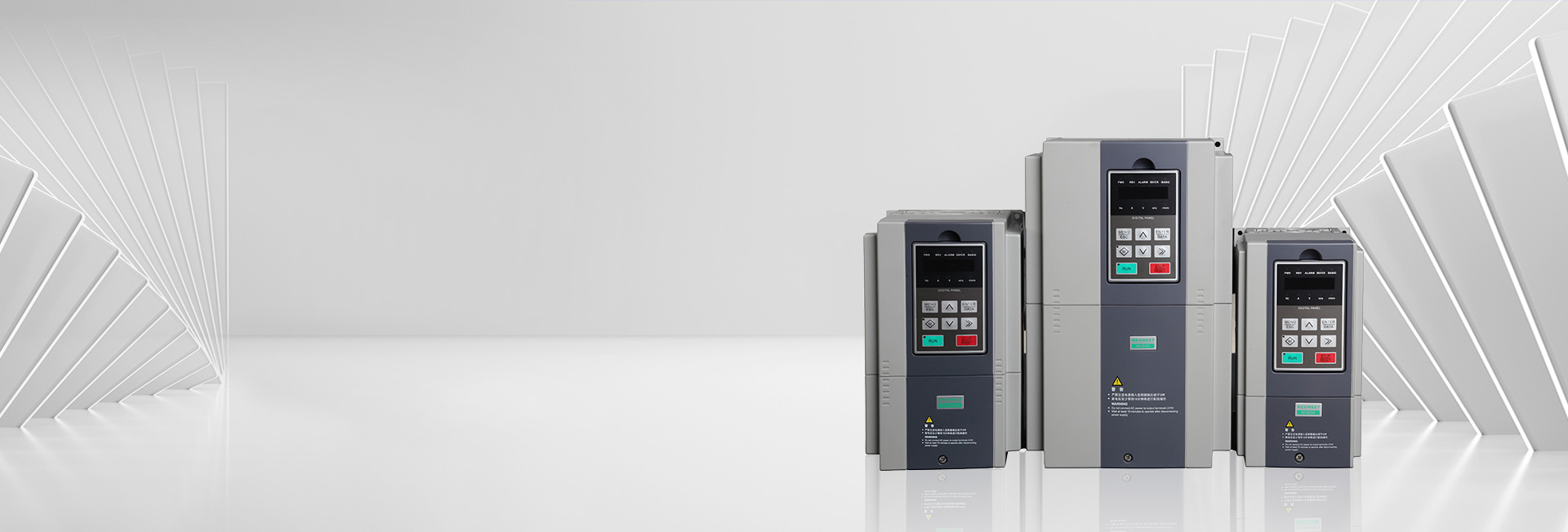
According to the above principles, after various investigations and comparisons, the manufacturer finally chose the MV300G series general-purpose inverter of McGermant, so that the system can meet the requirements of the above working conditions.
1、MV300G is a current vector inverter with large low-frequency torque and strong overload capacity. It can work for more than 2 minutes at a rated load of 1.5 times above 10 Hz.
2、MV300G with standard DC reactor above 75kW can effectively reduce input side harmonics and reduce interference.
3、The acceptable input voltage range of MV300G fluctuates greatly, and it can work normally from AC 324 to 520V
4、The customer inspected the main key components of the inverter, such as rectifier bridge, inverter module, capacitor, main chip, etc., all of which use world-famous brands, which is the basic guarantee of product reliability.
5、Considering the upgrade of the entire factory automation in the future, it is required that the inverter can be built with PROFIBUS-DP bus and CANOPEN bus.
6、For maintenance and after-sales consideration, the customer requires the inverter to purchase two built-in 90kW and 75kW motor parameters
For this reason, the customer selected two MV300G-4T90 inverters.
Principles of transformation plan
The pressure closed-loop control system composed of frequency converter, pressure transmitter, regulator, motor, and spiral rotor automatically adjusts the motor speed, so that the air pressure in the gas storage tank is stable within the set range, and constant pressure control is performed. The system configuration is shown in the figure below.

Inverter wiring diagram
The feedback pressure is compared with the set pressure, and the output frequency of the inverter is controlled in real time, thereby adjusting the motor speed, so that the air pressure in the air tank is stabilized at the set pressure.

System debugging
The commissioning work is divided into two parts:
1、Debug the inverter-driven motor to ensure that the inverter-driven motor can normally accelerate, decelerate, and run at a constant speed. The inverter current is stable without oscillation, and the motor works normally. At this time, it is necessary to observe whether the pressure rise of the air compressor is stable, whether the pressure transmitter shows normal, and whether the equipment stops normally.
2、System linkage debugging
After the adjustment of the inverter drive motor, the system linkage debugging is carried out. The main steps of debugging:
① Connect the inverter to the system.
② Perform power frequency bypass operation.
③ Carry out the operation of the frequency conversion circuit, including two parts debugging of open-loop and closed-loop control:
Mainly based on the matching of the frequency of the inverter frequency rise and fall and the rise and fall of the air compressor pressure, do not produce pressure oscillations, but also pay attention to observe the mechanical resonance point, jump over the frequency near the resonance point, and see if it can go smoothly under shutdown Switch to the power frequency state, this is mainly to verify the wiring of the system.
Benefits after air compressor transformation
1、Energy saving
Compared with the traditionally controlled compressor, the inverter-controlled compressor has the most practical energy saving, and the compressor operating condition supplied according to the air volume demand is the most economical operation. The following table is the test parameter table of the motor before and after the modification of the 75kw air compressor:
| |
Current(A)
|
Voltage(V)
|
Frequency(Hz)
|
Actual power(KW)
|
Power saving rate(%)
|
|
Before transformation
|
122
|
380
|
50
|
65.3
|
0
|
|
After transformation
|
110
|
221
|
29
|
38.1
|
41.9
|
It can be confirmed from the above table that the power saving effect is very obvious. If the air compressor is calculated as 300 working days per year, it can save 195,800 kWh of electrical energy per year.
2、Lower operating costs
The operating cost of a traditional compressor consists of three items: initial purchase cost, maintenance cost, and energy cost. Among them, energy costs account for about 77% of compressor operating costs. The energy cost is reduced by 41.9%, and the impact on the equipment after the frequency conversion start is reduced, and the maintenance and repair volume are also reduced, so the operating cost will be greatly reduced.
3、Improve pressure control accuracy
The frequency conversion control system has precise pressure control capability. Match the air pressure output of the compressor with the air volume required by the user's air system. The output air volume of the inverter control compressor changes with the change of the motor speed. Due to the increased accuracy of the frequency-controlled motor speed, it can keep the system pressure change of the pipe network within the range of 3pisg, that is, within 0.2bar, effectively improving the quality of the working conditions.
4、Extend the service life of the compressor
The frequency converter starts the compressor from 0Hz, and its starting acceleration time can be adjusted, thereby reducing the impact on the electrical and mechanical parts of the compressor during starting, enhancing the reliability of the system, and extending the service life of the compressor. In addition, the frequency conversion control can reduce the current fluctuation of the unit during startup. This fluctuation current will affect the power consumption of the power grid and other equipment. The frequency converter can effectively reduce the peak value of the startup current to a minimum.
5、Reduce the noise of air compressor
According to the working condition requirements of the compressor, after the frequency conversion speed regulation transformation, the motor running speed is significantly slowed down, so the noise of the air compressor during operation is effectively reduced. Field measurements show that the noise is reduced by about 5 dB compared with the original system.